-1.png)
Yanjing Eight Crafts are a Beijing-centered group of imperial handicraft traditions: gold lacquer inlay, filigree inlay, cloisonne enamel, ivory carving, jade carving, carved lacquer, Beijing embroidery, and palace carpet. For a visitor, the useful point is not memorizing a list. It is learning how Beijing court taste used material, surface, color, and patient handwork to make objects feel ceremonial. This guide explains the eight crafts in plain English and shows how to read them inside a museum without turning the topic into souvenir shopping.
Key Takeaways
- Yanjing is an older name associated with Beijing, so the phrase points to Beijing’s court-linked craft culture.
- The eight crafts are craft families, not eight single objects. Each one has its own material logic.
- Cloisonne, carved lacquer, jade carving, and filigree inlay are usually the easiest for first-time visitors to recognize.
- Ivory carving belongs here as a historical museum category. It should not be treated as a buying recommendation.
- The China National Arts and Crafts Museum / China Intangible Cultural Heritage Museum is a practical place to start, but visitors should verify current booking and opening details on official pages before going.
What are the Yanjing Eight Crafts?
The Yanjing Eight Crafts are a commonly used way to group eight refined craft traditions associated with Beijing’s imperial and court-adjacent workshops. The Beijing Yanjing Eight Imperial Handicrafts Museum presents the set as gold lacquer inlay, filigree inlay, cloisonne, ivory carving, jade carving, carved lacquer, Beijing embroidery, and palace carpet.
“Yanjing” is a historic name tied to Beijing. In this phrase, it helps separate the subject from “Chinese crafts” in general. A blue-and-gold enamel vessel, a carved red lacquer box, and a jade ornament can all belong to Chinese craft history, but the Yanjing frame asks you to look at Beijing’s court taste: dense surfaces, auspicious motifs, expensive materials, and a slow, highly specialized division of labor.
English names vary. You may see “filigree inlay” for huasi xiangqian, “cloisonne” or “copper-body wire-inlaid enamel” for Jingtailan, and “palace carpet” for gongtan. Do not worry if museum labels use slightly different translations. The better question is: what material is being worked, and what kind of hand skill does the object show?
One caution matters. Ivory carving appears in historical lists because it was part of older court craft culture. For a modern visitor, treat it as a museum and conservation subject. It is not a shopping lead, and this article does not recommend buying ivory objects.
How should you read the eight crafts in a museum?
Start with four questions: what is the base material, how was the surface built, how much hand labor is visible, and what role might the object have played? This works better than trying to “like” or “dislike” the object at first glance.
| Craft family | What to look for | First-time visitor cue |
|---|---|---|
| Gold lacquer inlay | Lacquered wood, metallic shine, inlaid shell, bone, stone, or other hard material | The surface often feels layered, glossy, and architectural. |
| Filigree inlay | Fine metal wires, small soldered forms, inset stones or enamel | Look for thread-like metal lines that build a pattern. |
| Cloisonne enamel | Metal body, wire cells, colored enamel, polished surface | Bright color sits inside tiny metal borders. |
| Ivory carving | Historic carving category using ivory as the material | Read as conservation and history, not a purchase idea. |
| Jade carving | Stone color, translucency, polish, carved forms | The artist often works with the stone’s natural color and flaws. |
| Carved lacquer | Thick lacquer layers cut into relief patterns | Red carved lacquer can look like a surface made from time. |
| Beijing embroidery | Silk thread, fine stitching, pictorial or symbolic motifs | Look closely at thread direction and shading. |
| Palace carpet | Woven textile, formal borders, repeated motifs | Notice the pattern system before the individual detail. |
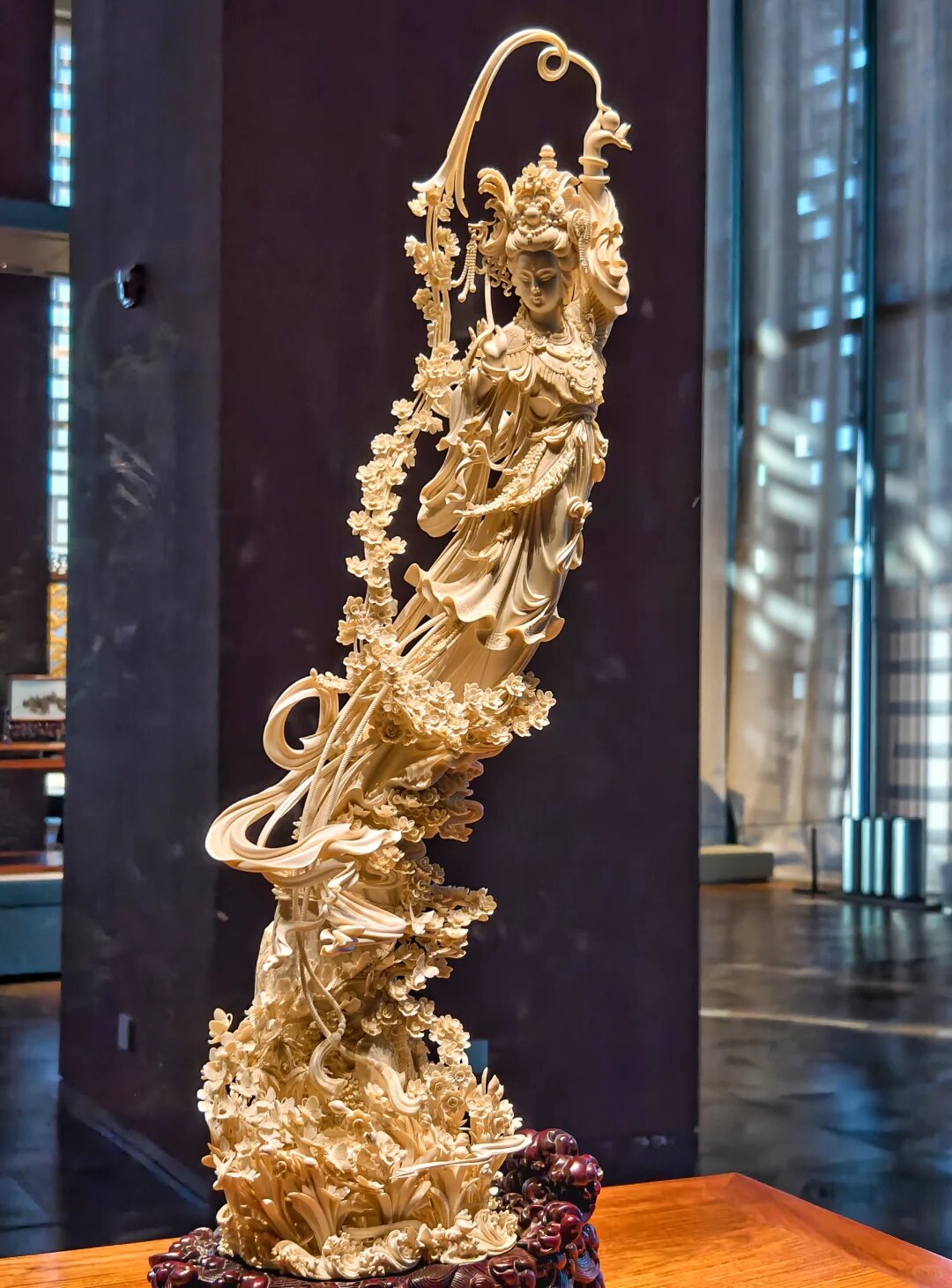
This approach helps because the same motif can travel across materials. A lotus, cloud, dragon, bat, or ruyi shape may appear in enamel, embroidery, jade, or lacquer, but each craft makes the motif behave differently. Enamel turns it into color cells. Embroidery turns it into thread movement. Carved lacquer turns it into shadow and relief.
The official China National Arts and Crafts Museum collection pages organize objects by material families such as metal crafts, lacquerware and lacquer artistry, jade sculpture, and textile and embroidery. That is a useful signal for visitors: museums often teach craft through material first, then period, maker, or theme.
Why did these crafts matter at court?
These crafts mattered because they turned material control into ceremony. A court-associated vessel, screen, box, robe panel, carpet, or ornament was not only useful. It showed access to skilled labor, precious material, symbolic design, and time.
That does not mean every object in these craft families was made for an emperor. The safer reading is more specific: the Yanjing Eight Crafts preserve techniques and visual habits that were strongly shaped by Beijing’s court world, official workshops, elite patronage, and later museum collecting. A museum label may identify a specific date, maker, dynasty, or use. Trust the label before making a broad claim.
- Auspicious motifs: bats, peaches, lotus, clouds, dragons, and ruyi forms often carry wishes for good fortune, longevity, rank, harmony, or authority.
- Dense surfaces: many court-linked objects reward close looking. The surface is rarely empty.
- Material conversation: jade, metal, lacquer, enamel, silk, and carpet each create a different kind of shine, depth, or softness.
- Slow labor: the value is not only in the raw material. It is in repeated hand processes: wiring, firing, polishing, carving, stitching, weaving, and assembling.
This is why a small object can carry a large cultural signal. A carved lacquer box may look compact, but the surface may contain dozens of decisions about layer depth, knife angle, motif order, and polish. A filigree piece may look delicate, but its structure depends on heat, wire control, and precise assembly.
Where can you see Yanjing Eight Crafts in Beijing?
For most visitors, the practical starting point is the China National Arts and Crafts Museum / China Intangible Cultural Heritage Museum in Beijing. Its official English site lists permanent exhibitions and collection families that match several Yanjing craft themes, including metal crafts, jade sculpture, lacquerware, and textile and embroidery.
The museum’s official booking page, checked on June 30, 2026, says visitors can use WeChat to reserve admission and that admission is free. Treat that as a live detail to verify before you go, not a permanent promise. Museums can change reservation rules, holiday access, temporary exhibitions, and security requirements.
- Start with the permanent exhibition page and note the floor or hall named for Chinese arts and crafts.
- Pick two materials you can recognize: enamel and lacquer are good beginner choices.
- In the gallery, compare one object by color, one by surface relief, and one by material.
- Take a short note on the Chinese name if the label provides it. It will help you connect related objects later.
- If you visit another Beijing museum afterward, look for the same motif in a different material.
The Beijing Yanjing Eight Imperial Handicrafts Museum is also directly tied to the Yanjing Eight Crafts theme. Its public homepage presents the eight categories and can help readers understand the grouping. Check its current visitor information directly before planning a special trip.
For more culture-first reading paths, use ChinaWink’s WinkLife culture guides, Beijing travel stories, and broader China travel guide.
FAQ
Are the Yanjing Eight Crafts still made today?
Some related techniques are still practiced, taught, exhibited, and collected. The safest way to see current work is through museums, official exhibitions, and recognized craft institutions rather than random shopping claims.
Which Yanjing craft is easiest to recognize first?
Cloisonne and carved lacquer are usually easiest. Cloisonne has bright enamel colors divided by thin metal lines. Carved lacquer often has a deep red relief surface.
Is this the same as all Chinese traditional crafts?
No. The Yanjing Eight Crafts are a Beijing-centered grouping. They overlap with broader Chinese craft history, but the phrase points to Beijing court aesthetics and related workshop traditions.
Can visitors buy Yanjing Eight Crafts?
This article is a museum guide, not a buying guide. If you buy any craft object in China, avoid protected wildlife materials, ask for clear provenance, and do not treat tourist-market labels as proof of heritage status.
What should I check before visiting a museum?
Check the official museum page for reservation method, opening hours, temporary closures, ID requirements, current exhibitions, and photography rules. Do this close to your visit date.
Content Statement
This article was built from public topic signals, official museum pages, and publicly visible craft-institution information checked on June 30, 2026. Social platform posts were used only to identify reader interest. They were not translated into the article, and their images were not reused. Visitor rules can change, so readers should verify official museum pages before making plans.