-e1742971339568.png)
Culture
Chinese Architecture: rooflines, courtyards, gates, and spatial order.
Chinese architecture is read through roof curves, courtyards, gates, axis, enclosure, material detail, and the relationship between people and place.
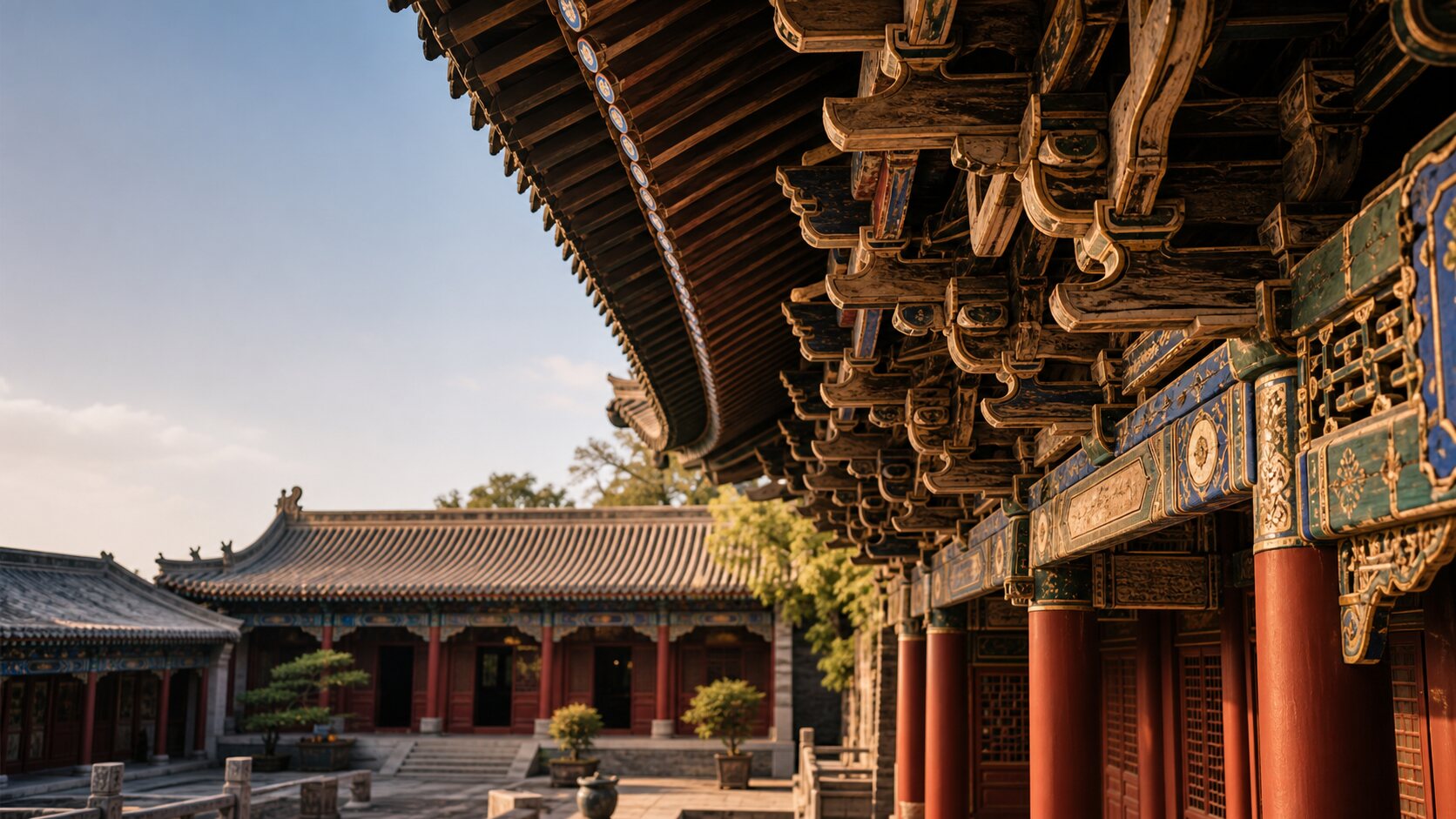
Roofline
Curves, eaves, tiles, and silhouette announce the building from a distance.
Bracket Sets
Dougong reveals timber logic, hierarchy, and craft detail.
Courtyard Order
Inward-facing space organizes family, light, privacy, and ritual movement.
Timber Joinery
Wood structure carries flexibility, repair, and visible craft intelligence.
Color Hierarchy
Red, gold, green, blue, and tile color can signal place and status.
Guide to Chinese architecture basics without turning the page into a technical encyclopedia.
Chinese architecture is read through roof curves, courtyards, gates, axis, enclosure, material detail, and the relationship between people and place.
Chinese discussions often focus on why roofs curve, why courtyards matter, and how old buildings organize family and ritual order.
Visual vocabulary
These are the visible clues the page should teach first, so the topic feels inspectable rather than abstract.
Chinese Architecture in four answers
A concise answer layer for readers and generative search systems before the deeper visual notes.
How to read it
Use these entry points to understand the object, food, or tradition as culture rather than as a disconnected fact.
Roofline as identity
A roof can signal region, status, climate, temple use, or courtyard atmosphere.
Courtyard logic
Courtyards create a balance of privacy, family order, light, air, and inward-facing life.
Thresholds and frames
Doors, gates, windows, walls, and corridors turn movement into a sequence of views.
What to notice
Look at how the roof meets the wall.
Watch the sequence from gate to courtyard to hall.
A garden view is often designed as a framed composition.
Related places
City pages act as cultural containers, connecting this topic to places, scenes, and local rhythm.
 Beijing
A place context for Chinese Architecture: streets, food, objects, architecture, and local rhythm.
Beijing
A place context for Chinese Architecture: streets, food, objects, architecture, and local rhythm.
 Nanjing
A place context for Chinese Architecture: streets, food, objects, architecture, and local rhythm.
Nanjing
A place context for Chinese Architecture: streets, food, objects, architecture, and local rhythm.
 Shanghai
A place context for Chinese Architecture: streets, food, objects, architecture, and local rhythm.
Shanghai
A place context for Chinese Architecture: streets, food, objects, architecture, and local rhythm.
Continue with
Adjacent pages keep the reader moving through the content atlas instead of returning to a generic blog list.
Related stories from the library
All stories



Common questions
What makes traditional Chinese architecture distinctive?
Roof form, timber structure, courtyards, axial order, gates, brackets, walls, and framed views are among the most recognizable features.
Why are courtyards important?
They organize family life, privacy, air, light, ritual movement, and the relationship between built space and nature.