-e1742971339568.png)
Craft & Finds
Chinese Lacquerware: patience, layers, shine, and carved depth.
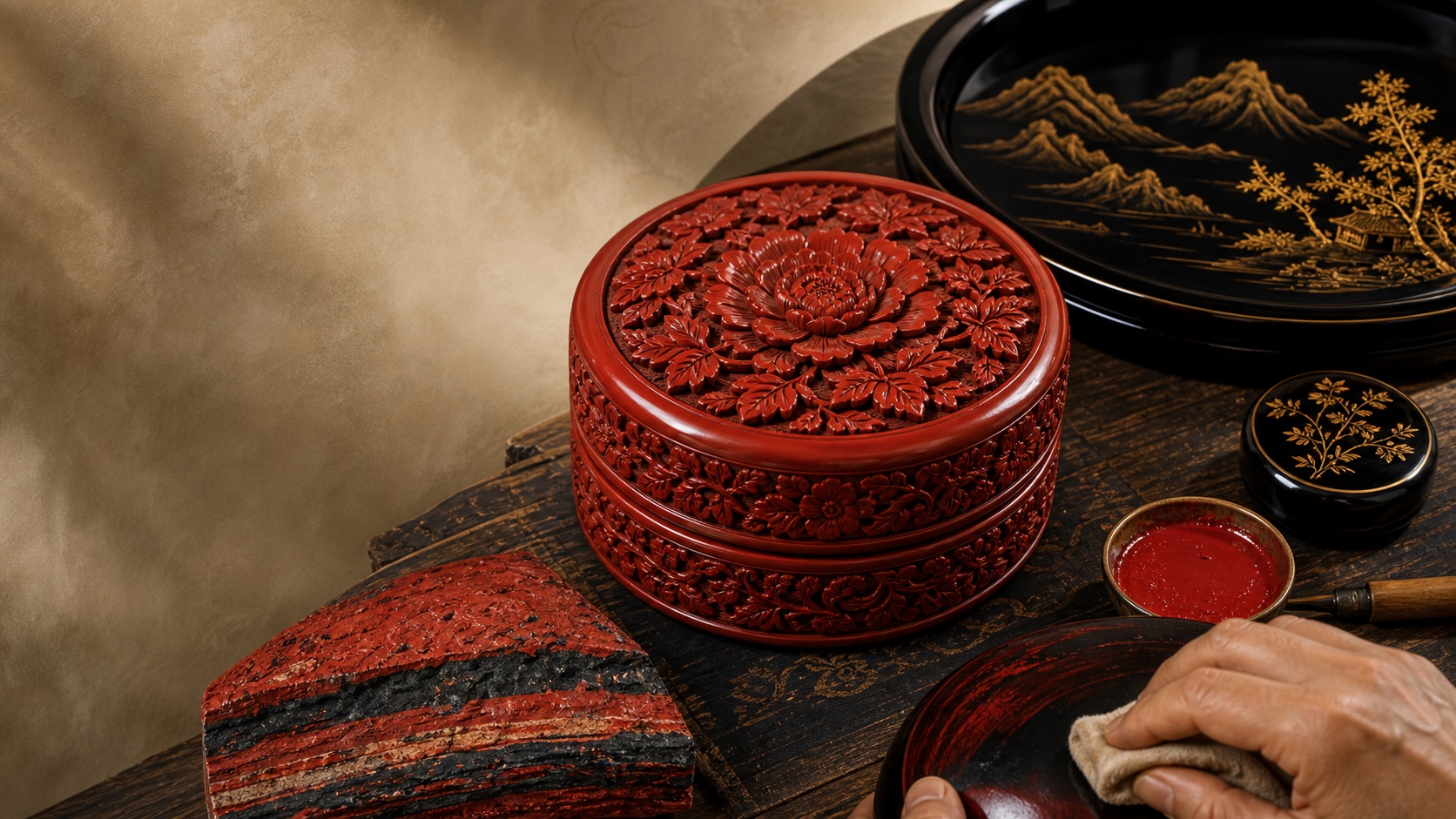
Lacquerware turns time into surface: layer after layer, polish after polish, until wood, cloth, or form becomes deep, glossy, and resilient.
Layer
Repeated coating and drying create depth before decoration appears.
Gloss
Shine is part of the material language, not only surface polish.
Carving
Relief patterns reveal time, control, and hand skill.
Black & Red
The strongest palette often works through restraint and contrast.
Patience
Lacquerware teaches craft as duration made visible.
Introduction to lacquerware materials, process, visual features, and why it feels different from ordinary painted objects.
Lacquerware turns time into surface: layer after layer, polish after polish, until wood, cloth, or form becomes deep, glossy, and resilient.
Chinese interest often centers on why lacquer takes so long, how carved lacquer differs from painted surface, and why old pieces feel deep.
Visual vocabulary
These are the visible clues the page should teach first, so the topic feels inspectable rather than abstract.
Chinese Lacquerware in four answers
A concise answer layer for readers and generative search systems before the deeper visual notes.
How to read it
Use these entry points to understand the object, food, or tradition as culture rather than as a disconnected fact.
Time as craft
Lacquer is a slow material. Much of its value comes from waiting, curing, sanding, and repeating.
Red and black language
Strong color contrast gives lacquerware a ceremonial and graphic presence.
Carved depth
Carved lacquer uses thick built-up layers so the pattern is cut into the object, not only painted onto it.
What to notice
Deep shine should feel layered, not plastic.
Carving should have rhythm and clean transitions.
Edges reveal a lot about patience and finish.
Related places
City pages act as cultural containers, connecting this topic to places, scenes, and local rhythm.
 Beijing
A place context for Chinese Lacquerware: streets, food, objects, architecture, and local rhythm.
Beijing
A place context for Chinese Lacquerware: streets, food, objects, architecture, and local rhythm.
 Nanjing
A place context for Chinese Lacquerware: streets, food, objects, architecture, and local rhythm.
Nanjing
A place context for Chinese Lacquerware: streets, food, objects, architecture, and local rhythm.
 Shanghai
A place context for Chinese Lacquerware: streets, food, objects, architecture, and local rhythm.
Shanghai
A place context for Chinese Lacquerware: streets, food, objects, architecture, and local rhythm.
Continue with
Adjacent pages keep the reader moving through the content atlas instead of returning to a generic blog list.
Related stories from the library
All stories
Common questions
Is lacquerware just painted wood?
No. Traditional lacquerware uses repeated lacquer layers and finishing processes that create depth, durability, and a specific tactile surface.
Why is carved lacquer valued?
Because the carved design depends on many built-up lacquer layers and careful cutting into that depth.