-e1742971339568.png)
Craft & Finds
Blue and White Porcelain: cobalt lines, white space, and global recognition.
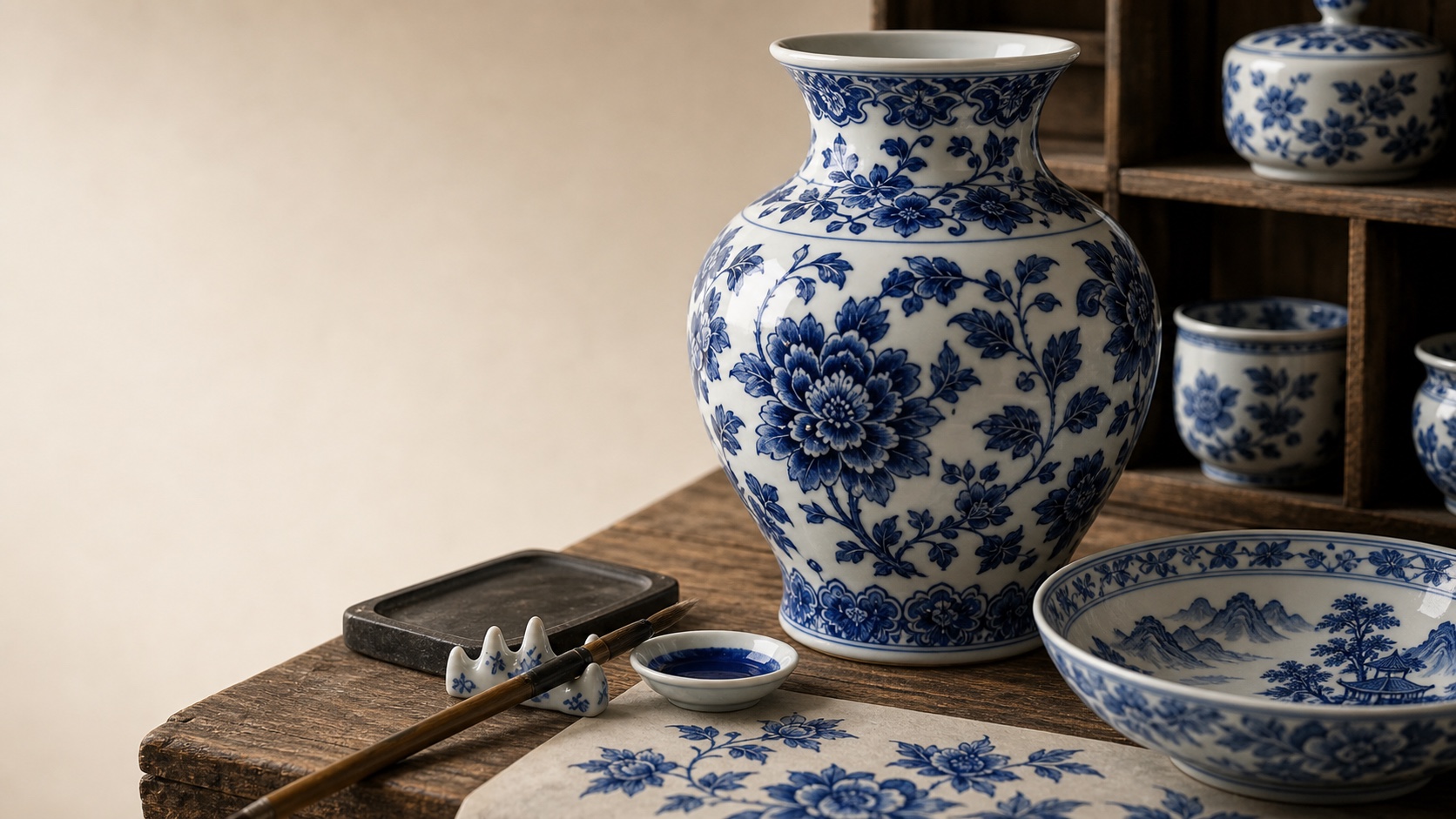
Blue and white porcelain turns a limited palette into a complete visual world: cobalt brushwork, clear glaze, white ground, and repeating symbols.
Cobalt
Blue pigment under clear glaze gives the surface its famous depth.
White Space
Empty ground controls rhythm as much as painted detail.
Border
Rims, feet, and shoulders divide the vessel into readable zones.
Motif
Lotus, peony, wave, cloud, dragon, and vine carry layered meanings.
Kiln Memory
Fire, clay, glaze, and brushwork turn technique into culture.
Help readers understand what blue and white porcelain means, why cobalt appears blue, and how to recognize common motifs.
Blue and white porcelain turns a limited palette into a complete visual world: cobalt brushwork, clear glaze, white ground, and repeating symbols.
Chinese discussions often focus on why it is called qinghua, why Yuan blue-white became important, and why the color sits under the glaze.
Visual vocabulary
These are the visible clues the page should teach first, so the topic feels inspectable rather than abstract.
Blue and White Porcelain in four answers
A concise answer layer for readers and generative search systems before the deeper visual notes.
How to read it
Use these entry points to understand the object, food, or tradition as culture rather than as a disconnected fact.
Underglaze blue
The pigment sits below the glaze, so the final surface feels smooth even when the brushwork looks alive.
Motif and border
Main scenes, shoulder bands, foot borders, and rim patterns divide the object into readable zones.
From court to home
Blue and white moved between elite display, export porcelain, temple objects, and ordinary tableware memory.
What to notice
Look at the thickness and flow of cobalt lines.
Notice whether the border supports the shape or fights it.
The blank white areas are part of the design, not empty leftovers.
Related places
City pages act as cultural containers, connecting this topic to places, scenes, and local rhythm.
 Beijing
A place context for Blue and White Porcelain: streets, food, objects, architecture, and local rhythm.
Beijing
A place context for Blue and White Porcelain: streets, food, objects, architecture, and local rhythm.
 Shanghai
A place context for Blue and White Porcelain: streets, food, objects, architecture, and local rhythm.
Shanghai
A place context for Blue and White Porcelain: streets, food, objects, architecture, and local rhythm.
 Nanjing
A place context for Blue and White Porcelain: streets, food, objects, architecture, and local rhythm.
Nanjing
A place context for Blue and White Porcelain: streets, food, objects, architecture, and local rhythm.
Continue with
Adjacent pages keep the reader moving through the content atlas instead of returning to a generic blog list.
Related stories from the library
All stories


Common questions
Why is it called blue and white porcelain?
Because cobalt blue decoration is painted on a white porcelain body and covered by a clear glaze.
Why do some pieces look gray-blue and others deep blue?
Cobalt source, pigment preparation, kiln condition, glaze, and later taste all affect the final tone.